

You know that feeling that you experience when you walk into a certain home and relax with your entire body? As if your shoulders dropped three inches and you remembered what it was like not to be tensed up? And then there are the other places that cause you to become anxious before you have even found a spot to put your bag.
However, it’s rarely about the room’s size or whether the sofa costs a fortune. As soon as you walk through the door, your body begins its own little reconnaissance mission. Your nervous system has opinions, and it’s forming them way before your conscious brain catches up with thoughts like “hm, yes, I enjoy this throw pillow.”

What Sensory Calm Means in Home Design?
Now, before we get into curtains and lighting, you must first know what sensory calm is not. It’s not about living in a silent beige box where all pleasure goes to die. Neither is it about performing some minimalist aesthetic for strangers online.
Sensory calm is about regulation. It involves creating a home that supports your nervous system’s function without causing it to continuously trip over needless turmoil and clutter. All you need to do is create an atmosphere that engages with your emotional baseline and make deliberate decisions that complement rather than conflict with your nature. You simply become conscious of how everything lands, but you still get to preserve your individuality and your colors.
Your home is one of the only places where you control nearly everything your senses encounter.
You decide what your eyes land on when you walk in. You choose whether the lighting feels gentle or harsh. You pick the surfaces your hands touch sixty times a day. Those small choices compound. They shape if you feel relaxed in your own space or vaguely on edge.
Environmental psychology proves that spaces with balanced sensory input reduce stress and improve mood because your brain doesn’t have to work as hard. This is also not another abstract theory. Hospitals figured this out ages ago. So did schools and fancy offices. Your living room is just fashionably late to the party.
Therefore, it is not magic if you enter a hotel room or a friend’s home and feel enigmatically at ease as if a design fairy had waved a wand. It is five things working together in a sensory alignment.
Texture
Because it’s subtle and we’re trained to think with our eyes first, texture is one of the most underappreciated elements in calming home design. However, texture is always there to interact with your body, even when you are not actively touching anything. Surfaces are interpreted by the brain as signals for security and comfort.
Texture Affects Mood
Hard and glossy surfaces are the overachievers of the material world. Marble, glass and polished concrete bounce light around and ping sound across the room in hopes of keeping the energy up. Which is fine! In small doses, that crispness can feel clean and energizing. But when your whole house is basically a gorgeous echo chamber of reflective surfaces, your nervous system never quite gets to exhale. Everything feels just a touch too bright and slightly echoey like living inside a beautiful seashell that won’t stop humming at you.
The opposite is true with softer and more irregular textures. Linen, wool, worn wood, matte plaster or anything with a little tooth or grain to it absorbs light and damps sound. They create visual and acoustic softness, which is your nervous system’s love language. And this isn’t just design intuition or vibes. Research on tactile perception shows that humans are hardwired to associate softness and irregularity with safety and care.
This does not imply that you have to live in a felt-only hut or cover every surface with large knit throws. Style and nervous system regulation are not mutually exclusive. That is a false dichotomy created by those who believe that “calming” equates to “boring.”
It just means getting intentional about layering. Mix your materials. Give your eyes and hands and ears a variety of textures to land on, so no single surface dominates the sensory experience. A concrete floor softened by a wool rug or cabinetry paired with a ceramic vase or a throw draped over the back of the sofa are great examples.
Use Softness Strategically
A home with sensory calm puts softness where you land. Upholstery you sink into. Rugs that cushion your steps. Curtains that move when you walk past them. Throws that end up in your lap without you meaning to grab them. Even your wall finishes matter more than you think.
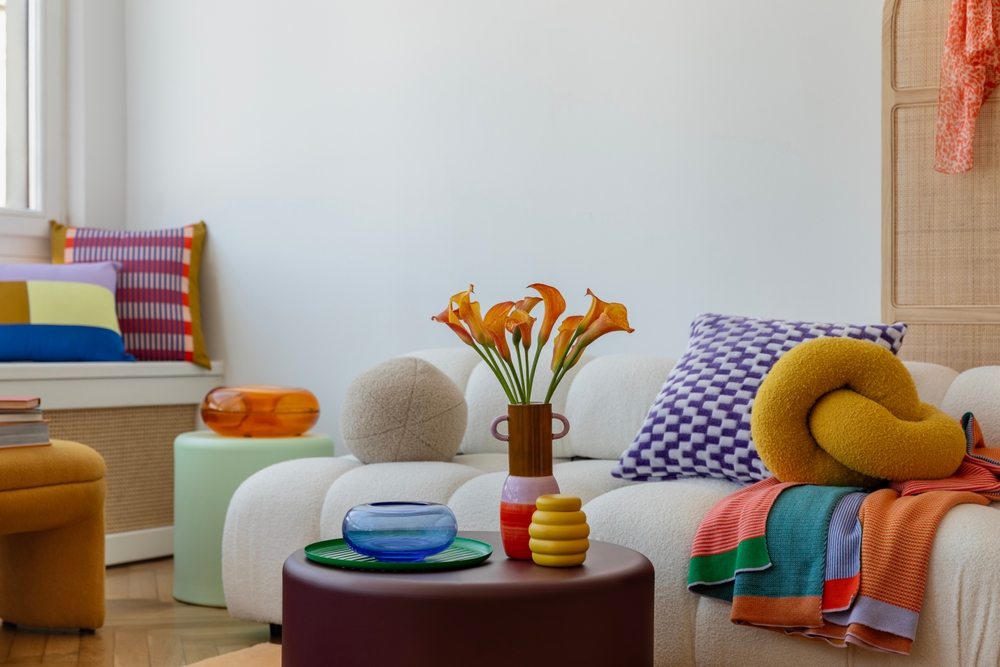
Natural fibers such as wool, linen, cotton and jute have a more calming effect than synthetic fibers. Another way to prevent a room from seeming visually flat without descending into chaos is to layer textures. A low-pile jute mat beneath a linen sofa with a large wool blanket conveys depth. Although your brain detects variance, it does not interpret it as conflict. Natural materials also have emotional weight. Human hands and craft are ingrained in them. They have a lived-in quality, rather than being extruded from a machine and transported in shrink wrap. That sense of being connected to something older and slower than the algorithm is more important than we like to admit when we pretend to be rational about throw pillows.
Design Psychology Trick – Anchor each room with one dominant texture, then let others support it. This keeps the sensory hierarchy clear.
Lighting
Lighting is the fastest way to completely change how a room feels as well as the thing most people get catastrophically wrong. Walk into almost any home and you’ll find rooms lit entirely by overhead fixtures or ceiling lights that make everything look like a dentist’s office or a police interrogation. They are convenient, sure. But your nervous system is not a fan.
The Biology of Light and Mood
Light directly affects your circadian rhythms and hormone production, along with how alert or relaxed you feel. Harsh and cool lighting suppresses melatonin and keeps your body in a low-grade state of activation. This is why you can feel weirdly wired at 10 p.m. even when you are exhausted. Warm and dim light signals to your brain that the day is winding down, that you’re safe, that it’s time to let your guard down.
This is chronobiology, the science of how living things respond to light and dark cycles. And design psychology has been borrowing from it for years.
The closer your home lighting mimics natural light patterns, the calmer and more regulated you tend to feel. This is why spaces with layered lighting feel inexplicably better, even if you can’t put your finger on why.
Build a Calming Lighting Scheme
A home with sensory calm uses multiple light sources at different heights through table lamps and floor lamps, perhaps wall sconces and even indirect lighting tucked behind furniture or along baseboards. The space lights from multiple sources simultaneously, as opposed to a single harsh overhead light that flattens everything.
Lighting in living rooms and bedrooms should be between 2700K and 3000K. That’s the warm, amber glow that reminds you of candlelight or sunset, the kind of light that makes everyone look better and feel more at ease. Cooler light that is 4000K or higher can be used anywhere you need to concentrate, like the kitchen or your workstation, but it should never take over areas where you are attempting to unwind.
Plus, dimmers are not a luxury. Being able to dial the brightness up or down depending on the time of day or your mood is one of the simplest yet most effective ways to make a space feel like it’s responding to you instead of the other way around.
Spatial Flow
Spatial flow is about how you move through your home physically and visually. It’s the difference between always making that awkward sideways shuffle by the coffee table that’s three inches too near to the sofa and gliding from room to room as you live in a space made for human beings.
A well-thought-out layout lowers friction. Micro stresses produced by a poorly built one compound more quickly than you might expect.
Layout Affects Emotional Well-Being
Your brain is constantly looking for barriers. It’s an evolutionary remnant from the days when you could end up as someone’s lunch if you fall over a pebble. Cluttered paths and random furniture arrangement with obstructed sightlines can increase cognitive load, which means your brain must work more to figure out a space that should be simple.
Your neurological system never completely stops responding to poor flow, even if you had lived somewhere for years and could get around it even wearing a blindfold.
Your body knows that you have to squeeze past the dining chair each time you go to the kitchen, even though you may not be aware of it. Clear spatial organization is directly linked to feelings of control and safety.
This becomes especially important in open-plan homes, where the absence of walls can create what can be called sensory sprawl. The kitchen is also the living room is also the dining area is also where you are trying to have a quiet moment, and suddenly nowhere feels like it has a clear purpose. It’s visually and mentally exhausting.
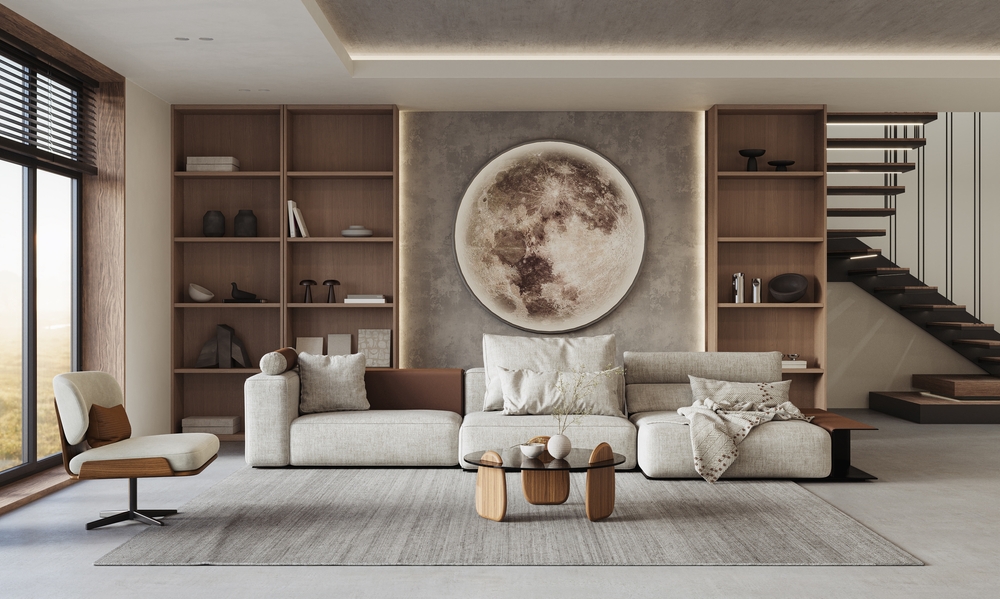
Design for Flow
Creating spatial flow doesn’t require hiring an architect or knocking down walls. You just have to be brutally honest about how you actually live versus how you think you’re supposed to live.
Paths of movement should feel obvious. Furniture should define zones without barricading them. Your sofa can create a boundary between the living area and the dining space without literally blocking the path. A rug can signal “this is where we sit and talk” without requiring a velvet rope.
Negative space is not wasted space. It’s where your eye gets to rest. Give your space and yourself permission to have some emptiness.
Design Psychology Trick – Align furniture with natural lines of sight. When you walk into a room, your eye should land on something intentional. It could be a piece of art or a window with a view. Guide the eye towards somewhere pleasant to go.
| Design Adjustment | Relative Cost | Effort Level | Speed of Impact | Sensory Shift | Why It’s Worth Considering |
|---|---|---|---|---|---|
| Swap Bulbs to Warm LEDs | Low | Low | Immediate | Softer visual field, reduced glare | One of the fastest ways to recalibrate how a space feels, especially in the evening |
| Add Layered Lighting (Lamps, Wall Lights) | Moderate | Low–Moderate | Immediate | More balanced light distribution | Creates control over brightness and mood without structural changes |
| Introduce Soft Textiles (Rugs, Throws, Curtains) | Low–Moderate | Low | Immediate | Dampened sound, tactile comfort | Instantly reduces harshness in both sound and touch |
| Declutter Visible Surfaces | Free | Moderate | Immediate | Lower visual stimulation | Clears mental “background noise” without requiring purchases |
| Rearrange Furniture for Flow | Free | Moderate | Immediate | Easier movement, less friction | Often overlooked, but can dramatically shift how a room is experienced |
| Upgrade Window Treatments | Moderate | Moderate | Short-Term | Controlled natural light, reduced glare | Helps regulate brightness throughout the day without constant adjustment |
| Standardize Materials (Wood Tones, Fabrics) | Moderate | Moderate | Gradual | Visual cohesion | Subtle consistency builds a sense of calm over time |
| Add Acoustic Elements (Wall Panels, Heavier Drapes) | Moderate | Moderate | Short-Term | Reduced echo and sharp noise | Particularly valuable in open or hard-surfaced spaces |
| Choose Rounded or Soft-Edge Furniture | Moderate–High | Moderate | Gradual | Reduced visual tension | A longer-term shift that softens the overall feel of a room |
| Create Intentional Empty Space | Free | Low | Immediate | Visual breathing room | Reinforces calm without adding anything new |
Color
Color deserves a seat at the table, but it doesn’t need to be the loudest person in the room. A home designed for sensory calm should have color to back up texture and light.
Muted tones tend to feel calmer than highly saturated ones, which means opt for clay instead of fire-engine red and moss instead of neon green. These colors have depth. They shift subtly depending on the light and time of day.
High-saturation colors are also not bad as a whole. They are just stimulating and stimulation has its place in maybe a piece of art where it surprises you in a fun way. But when every wall is yelling at full volume, your nervous system never gets a break. It’s like living inside a highlighter.
Neutrals are also not inherently calming. The difference between a neutral that feels calming and one that feels like a waiting room often comes down to warmth and complexity. Builder-grade beige or that specific shade of gray that makes everything look like a sad corporate office can feel just as sterile and stressful as a room drenched in chartreuse.
Your Color Associations Are Yours
Design psychology also reminds us that color associations are cultural and deeply individual. Blue might feel calming to you because it reminds you of your grandmother’s kitchen. It might feel cold and sad to someone else because it was the color of their childhood bedroom where they felt lonely.
A sensory calming home reflects your emotional history, not an algorithm-generated mood board or whatever Pantone declared the color of the year. If a certain shade of green makes you feel grounded because it reminds you of a place you loved, use it.
Sound
Sound is the invisible layer of home design that most people completely forget about until they are living with it. And by then, it’s often too late because then you are lying awake at 2 a.m. wondering why every footstep sounds like a small earthquake or why conversations in your open-plan kitchen echo like you are shouting into a canyon.
A lot of the textural choices we have already talked about have an acoustic aspect too. They soften the auditory edges of your space in ways you might not consciously notice, but your nervous system absolutely does.
Hard surfaces are also acoustically unforgiving. Sound hits them and ricochets. It’s why restaurants with concrete floors and exposed ceilings are always so loud.
A sensory calm home is a space where sound is controlled. The hum of the city filtered through heavy linen curtains feels completely different from that same noise bouncing sharply off bare walls and glass. You don’t need to soundproof your house or install acoustic panels on every wall.
How to Create a Home with Sensory Calm Without Starting Over?
You’ve just read several thousand words about texture and lighting and spatial flow, and maybe you’re sitting there thinking, “Great, so I need to gut my entire apartment and start from scratch with a lighting designer and a degree in environmental psychology.”
You don’t.

Sensory calm doesn’t require a full redesign with a big budget or even that much time. It comes from small but cumulative adjustments.
Pick the room where you feel most on edge. Now pay attention to what your body reacts to first. Don’t overthink it. Just notice. Is it light glare blasting you in the face every evening? Or is it clutter from a thousand small things competing for attention? Pick one of those things. Just one. And address it.
You don’t have to overhaul your entire life to feel better in your home. You just have to stop ignoring the things your body’s been trying to tell you all along.
Creating Spaces That Quiet the Mind
Calm is not something you stumble into because you bought the right throw pillow or painted your walls the trendy shade of greige. It’s something you design intentionally, by paying attention to how your space actually makes you feel rather than how it photographs.
So go ahead. Replace that overhead light. Add the soft thing. Clear the visual clutter. Listen to what your body’s been trying to tell you.